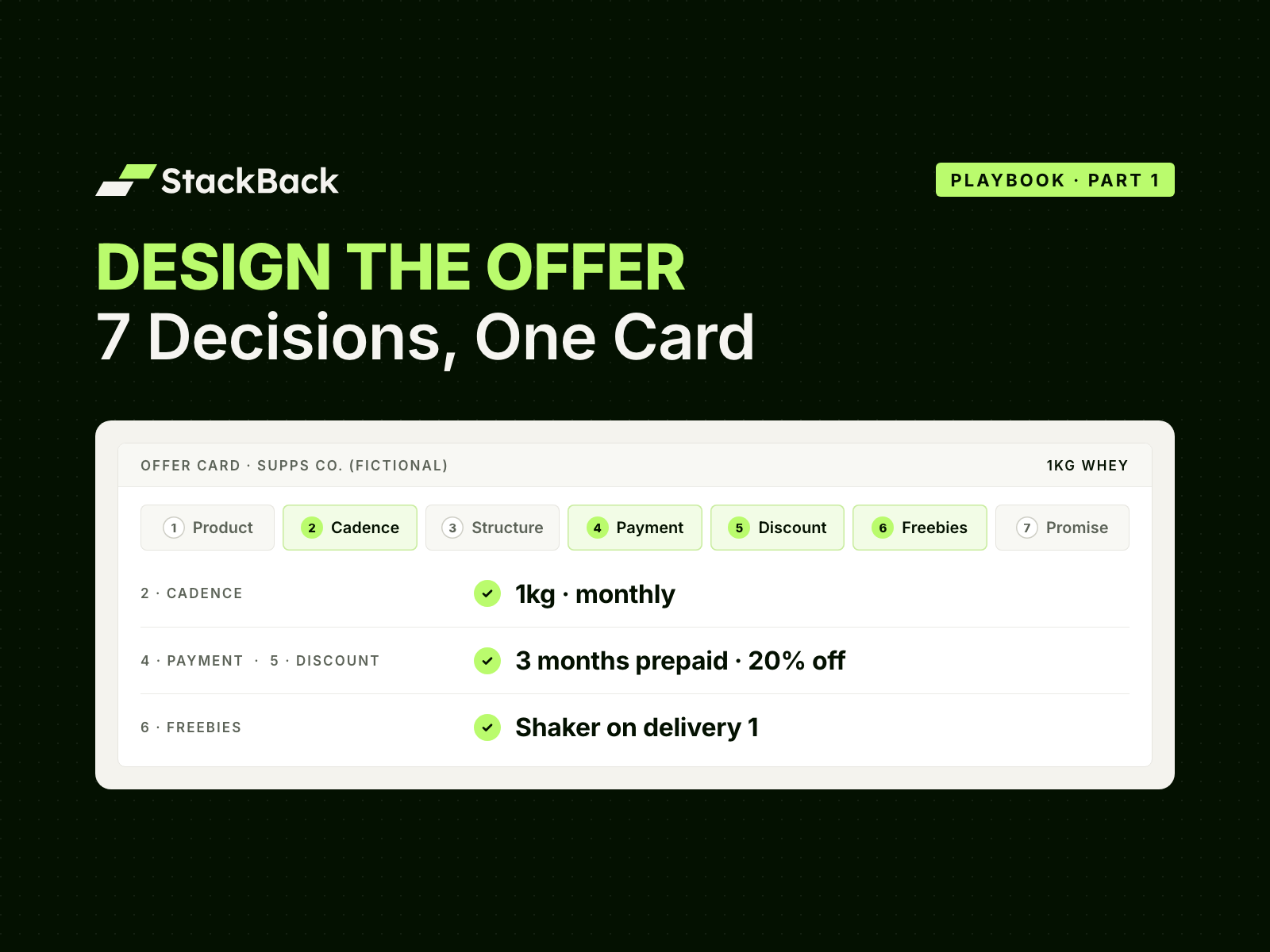
Your best subscription offer is already in your order history. This is Part 1 of the Desi Subscriptions Playbook. It covers seven decisions, in the order they depend on each other, that turn repeat buyers into one offer. Part 2, How to Get Your First 100 Subscribers on Shopify, takes that offer to launch.
It's for founders and growth leads at Indian D2C brands on Shopify. You sell something people finish and buy again: atta, ghee, coffee, tea, protein, supplements, diapers, pet food, pads, razors, skincare or detergent. Pick one product and work through all seven decisions for it. Write each answer on the offer card at the end.
Every example uses Supps Co., a fictional whey protein brand. Its 1kg tub sells at ₹2,400, ex-GST.
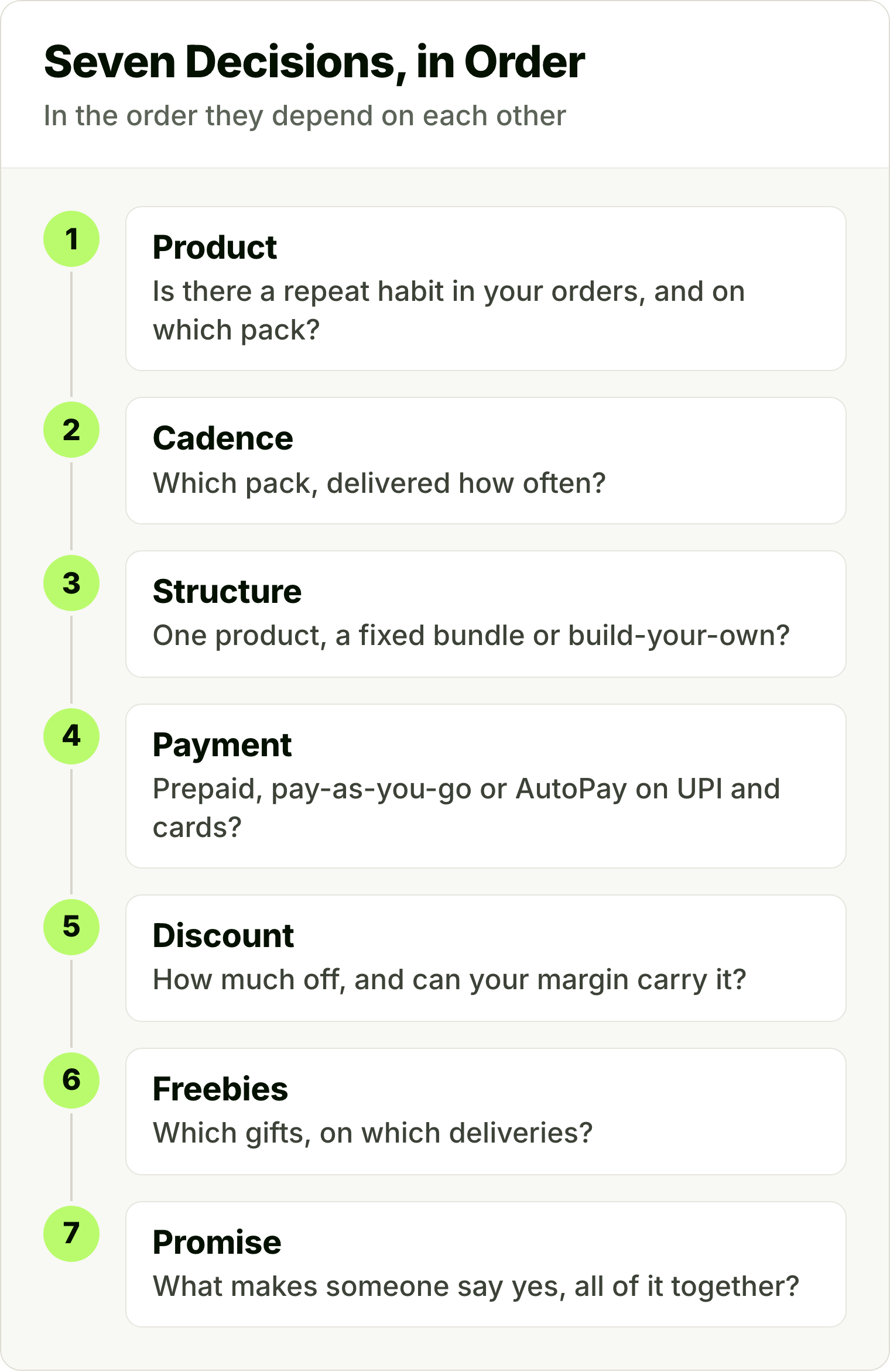
The Seven Decisions at a Glance
| # | Decision | The question it answers |
|---|---|---|
| 1 | Product | Is there a repeat habit in your orders, and on which pack? |
| 2 | Cadence | Which pack, delivered how often? |
| 3 | Structure | One product, a fixed bundle or build-your-own? |
| 4 | Payment | Prepaid, pay-as-you-go or AutoPay on UPI and cards? |
| 5 | Discount | How much off, and can your margin carry it? |
| 6 | Freebies | Which gifts, on which deliveries? |
| 7 | Promise | What makes someone say yes, all of it together? |
1. Product: Start With the Pack People Already Buy Again
Build the first offer on the product people come back for, not your bestseller by revenue. Three numbers for each pack decide it:
- Repeat share: of everyone who bought the pack in a year, the share who bought it again.
- Repeat buyers: people who bought it in two or more orders. This is your invite list.
- Days between repeats: 365 ÷ orders per repeat buyer. This is your starting cadence.
Supps Co. (fictional) sold its 1kg whey to 1,900 people in a year. Of those, 620 bought it again, at about 11 orders a year each. That's a 33% repeat share and a gap of about 33 days.
Two ShopifyQL queries in Shopify Analytics give these numbers for every pack. They're in our guide Which Products to Sell on Subscription.
On the card: your audience, and the winning pack's repeat share and gap.
2. Cadence: Let the Pack Size Set the Rhythm
The customer picks the pack that fits their household, and the delivery rhythm follows from how fast they finish it. A 1kg tub at one 30g scoop a day lasts about 33 days, so it ships monthly.
Offer two or three packs, each with its own rhythm: 1kg monthly, 2kg every two months. Never one pack with a menu of frequencies the customer has to guess. The Stack sells 30 servings monthly, 60 every 2 months and 90 every 3 months. Boojee Cafe ships 250g fortnightly and 1kg monthly.
Don't let the calendar set it. An atta brand that defaults its 5kg pack to monthly loses a week of sales every month. A family of four finishes 5kg in about three weeks, then buys the gap from the kirana or quick commerce.
How long common packs last, and how to check your rhythm against real orders: Which Products to Sell on Subscription.
On the card: your packs and each one's rhythm. Make your best-selling repeat pack the default.
3. Structure: Single Product, Fixed Bundle or Build-Your-Own
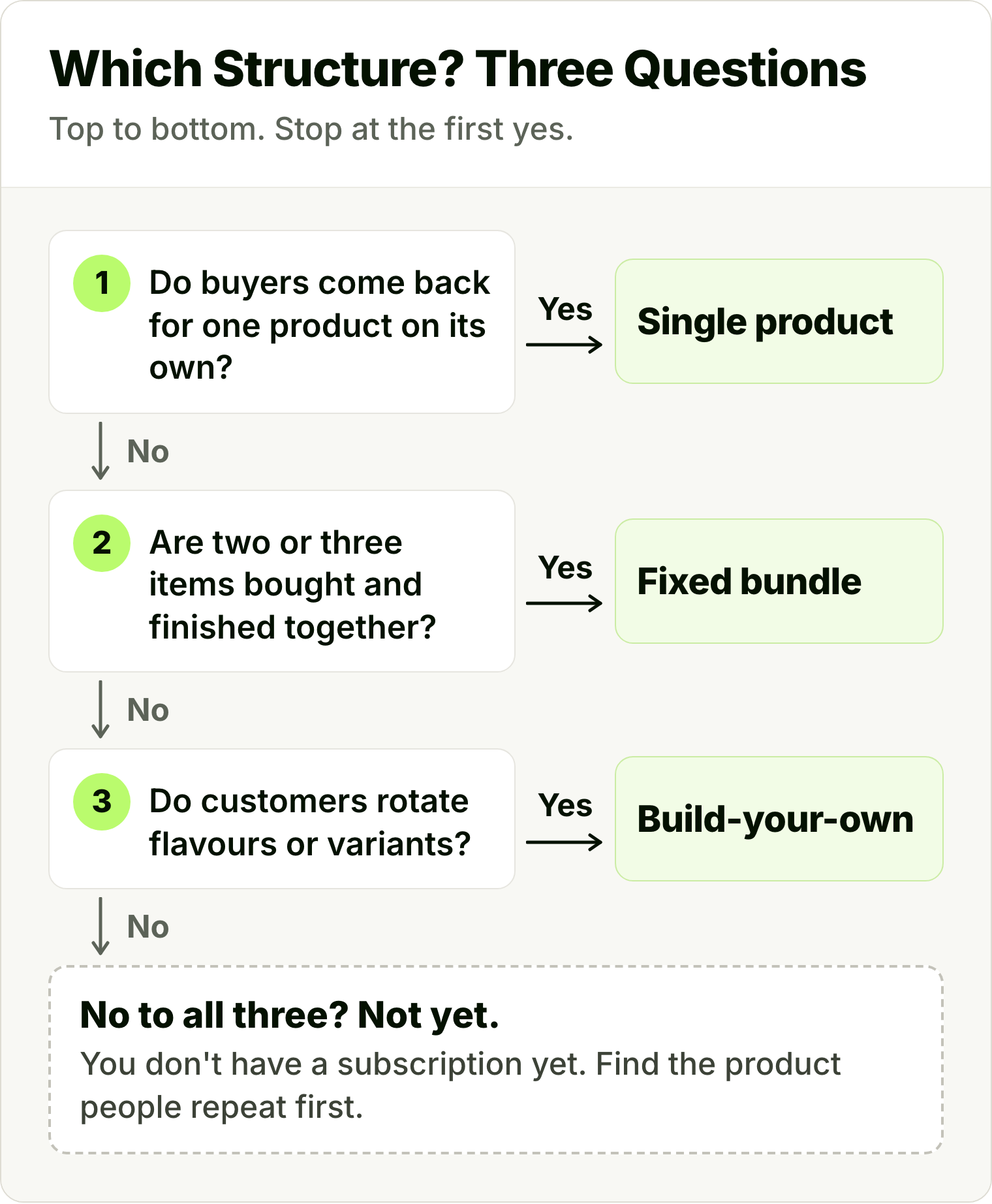
Ask three yes-or-no questions, top to bottom, and stop at the first yes.
- Do buyers come back for one product on its own? Then sell a single product. It's the right first offer for most brands. MillD sells one atta in two pack sizes.
- Are two or three items bought and finished together? Then a fixed bundle can work. The test is how fast each runs out, not whether they share a cart. Atta, ghee and jaggery fail: they run out weeks apart.
- Do customers rotate flavours or variants? Then offer build-your-own: a fixed number of slots from a short menu. Think 4 of 8 dals, or 2kg of protein across flavours, as The Func Lab does.
No to all three? You don't have a subscription yet. Find the product people repeat first.
| Structure | Customer effort | Your operations | When it fails |
|---|---|---|---|
| Single product | Lowest: pick a pack | One SKU to forecast | They want variety and leave to get it |
| Fixed bundle | Low: one price, a known box | Bundle stock moves together | Items run out at different speeds |
| Build-your-own | Highest: they choose each time | More packing errors | Too many options; the box never gets filled |
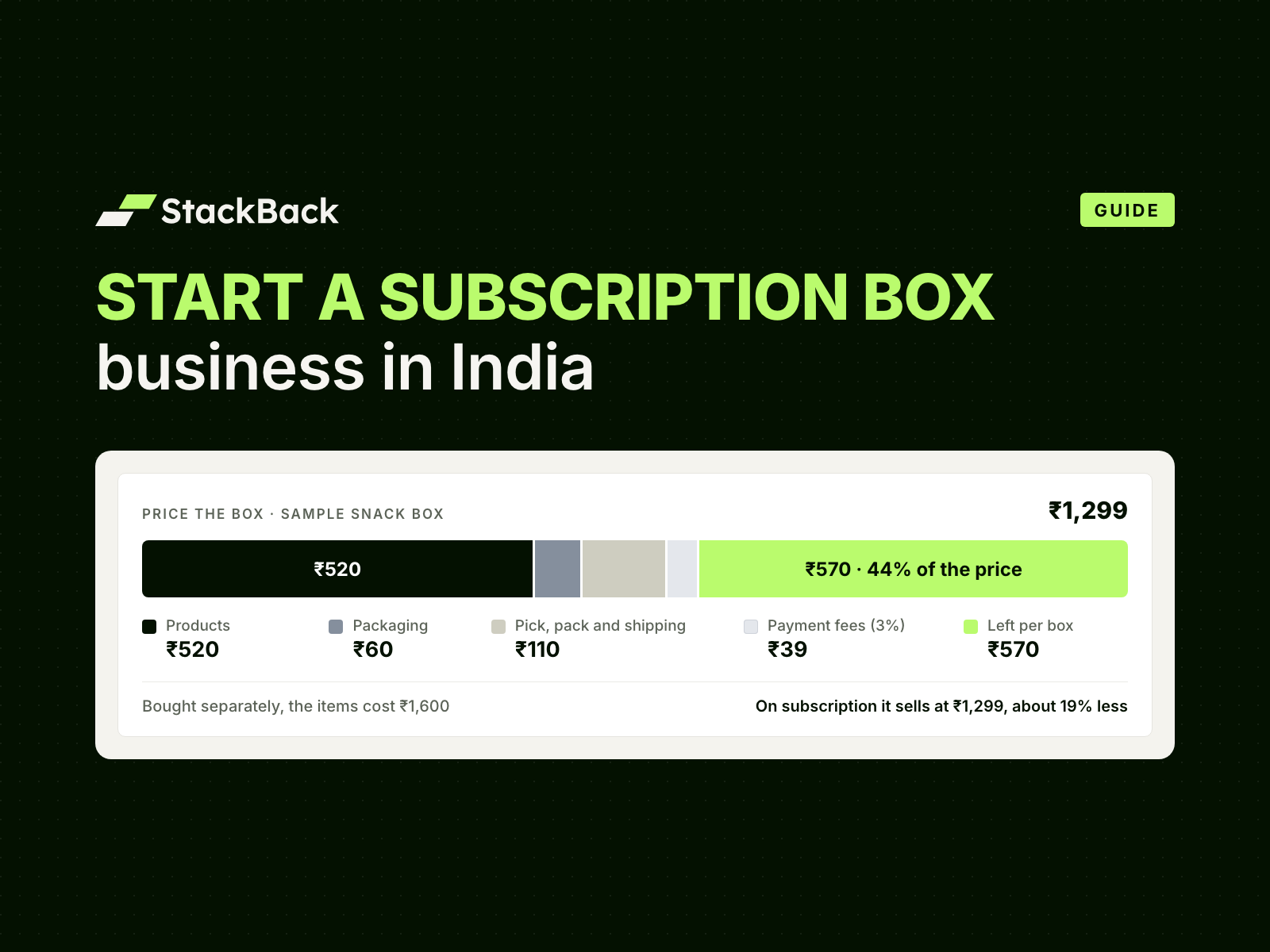
Show one-time add-ons and freebies apart from what repeats, so nobody expects them every month. Box types, box cadence and box pricing are in How to Start a Subscription Box Business in India.
On the card: one structure.
4. Payment: Prepaid, Pay-As-You-Go or AutoPay on UPI and Cards
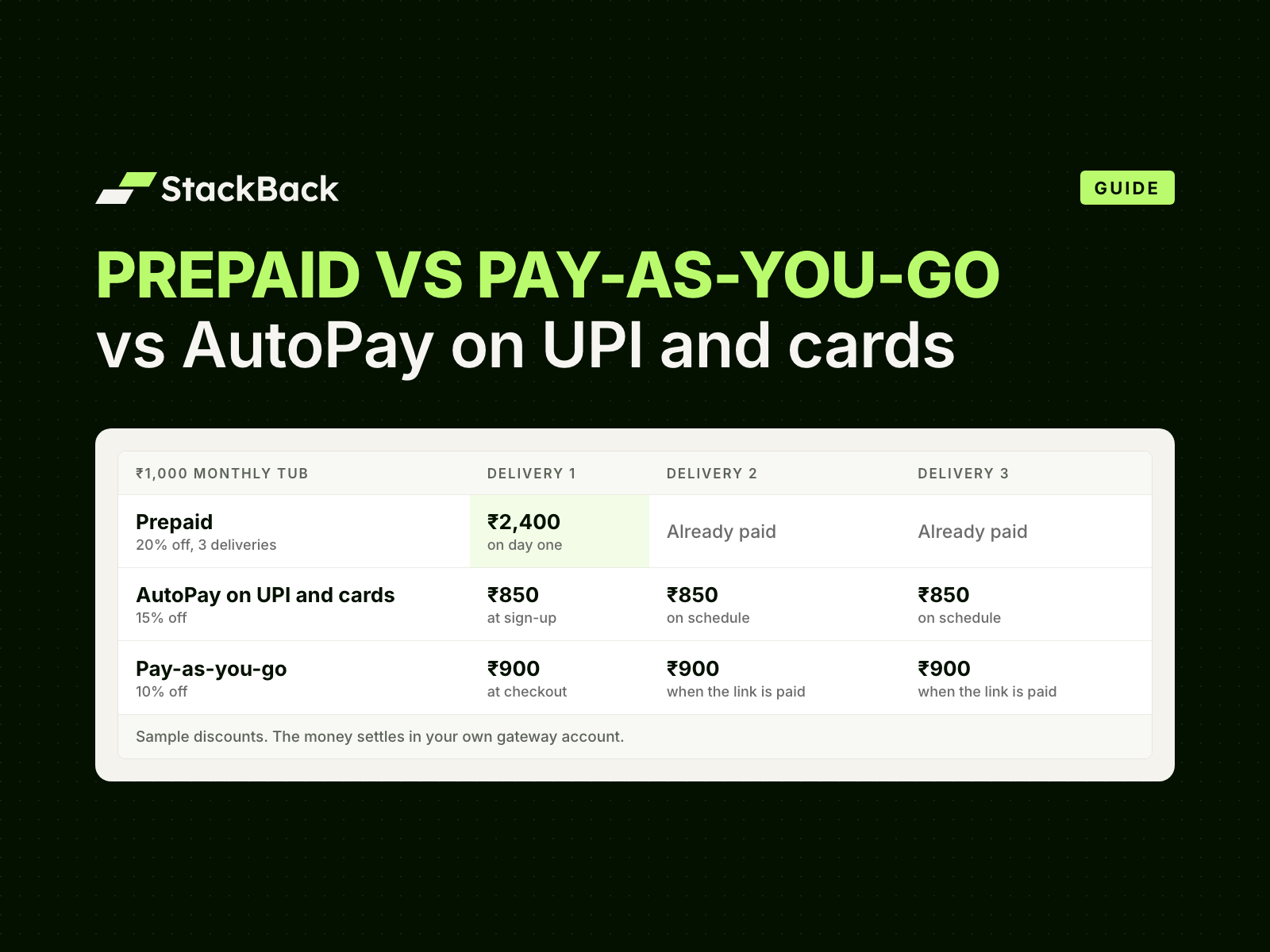
These are three different customers, not three settings. Month 1 is the same for all three: they subscribe and pay for the first delivery. After that, they part ways.
| Model | Who it suits | Month 1 | Months 2 and 3 |
|---|---|---|---|
| Prepaid | Trusts you and wants the best price | Pays ₹5,760 once for three tubs | Nothing to pay. The tubs arrive |
| AutoPay on UPI and cards | Wants it to run itself | Pays ₹2,160 and approves AutoPay once | A notice 48–72 hours ahead, then ₹2,160 is charged |
| Pay-as-you-go | Wants the ease, without AutoPay | Pays ₹2,160 | A payment link by email before each delivery. They tap to pay |
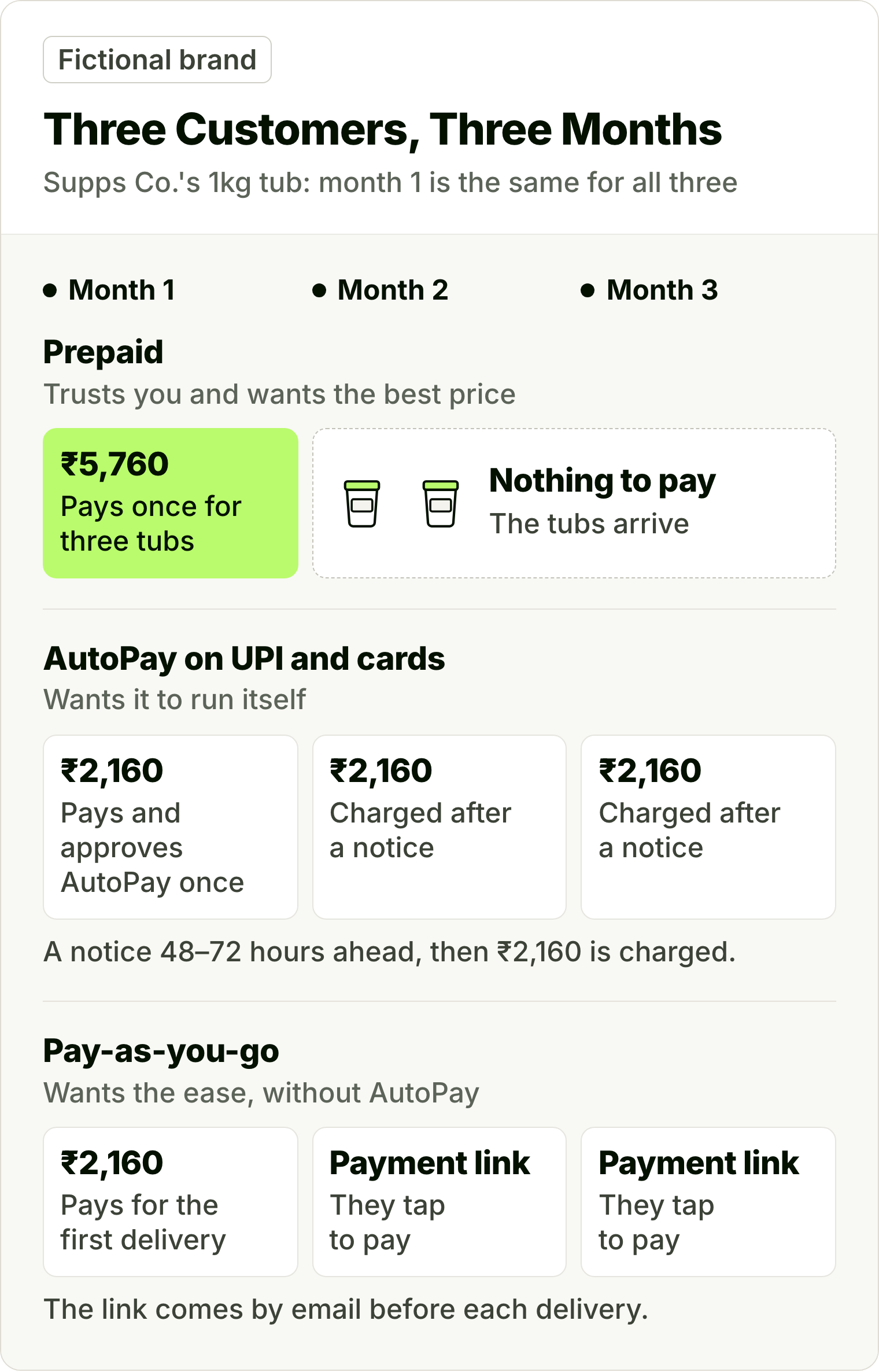
Supps Co. (fictional): 20% off for three tubs prepaid, 10% off per delivery.
- Prepaid gives you cash upfront to fund the next batch. The biggest discount belongs here.
- AutoPay on UPI and cards is the repeat with the least friction. Keep each charge under ₹15,000, so no fresh OTP is needed. The rules are in UPI and Card AutoPay Rules.
- Pay-as-you-go wins customers who never set up AutoPay. It's also a fallback when an AutoPay payment fails.
Start with two models, not three. Prepaid and AutoPay on UPI and cards is the strongest pair. Add a second model only if you can name the customer it serves. Cash flow, churn and which products suit each model: AutoPay vs Prepaid vs Pay-As-You-Go.
On StackBack, the AutoPay setup, notices before each charge, retries and pay-as-you-go payment links all run for you. A failed AutoPay payment is retried up to three times. Then the subscription pauses or moves to pay-as-you-go, whichever you choose. Nothing ships unpaid.
On the card: your main payment model and term.
Run All Three Side by Side
Prepaid, pay-as-you-go and AutoPay on UPI and cards, on one product page. Payments settle in your own gateway account, and our team takes you live in 2 days.
5. Discount: Biggest Where the Customer Commits Most
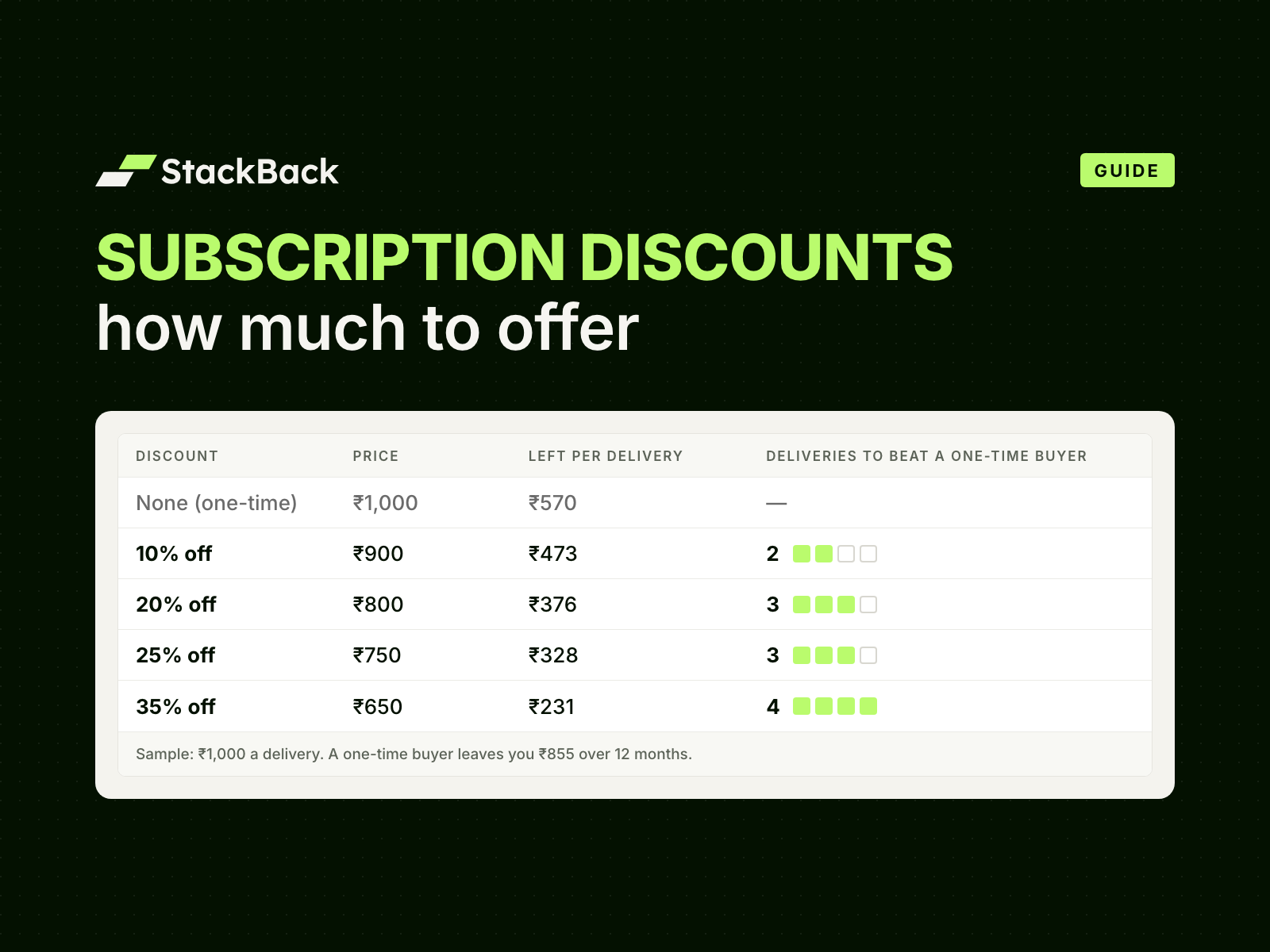
In our experience, a subscription in India converts at 15–20% off or more. Put the biggest discount on the plan where the customer commits the most. Prepaid brings cash on day one and a customer who has decided, so 20% belongs there. AutoPay and pay-as-you-go carry less, because the customer kept the option to stop.
Brands already price this way:
- Blue Tokai gives 10% off 3 deliveries, 12.5% off 6, 17.5% off 12 and 20% off 24.
- Setu gives an extra 10% off 30 servings, 15% off 60 and 20% off 90.
- AG1 gives its 90-day plan a bigger saving than its 30-day plan.
Beat your own everyday discount. If one-time prepaid orders already get 5% off, a 5% subscription saving is nothing. Customers keep buying one at a time, forget once and order whatever quick commerce has. If that isn't you, they've switched.
Avoid three things. A discount under 10% goes unnoticed. A flat deep discount on everything makes the one-time price look dishonest. And never pick a number without a margin check.
Run the margin check on one delivery. Supps Co.'s ₹2,400 tub at 20% off: ₹480 discount, ₹900 product, ₹135 to pack, ship and support, and ₹57.60 in payment fees. It keeps ₹827.40.
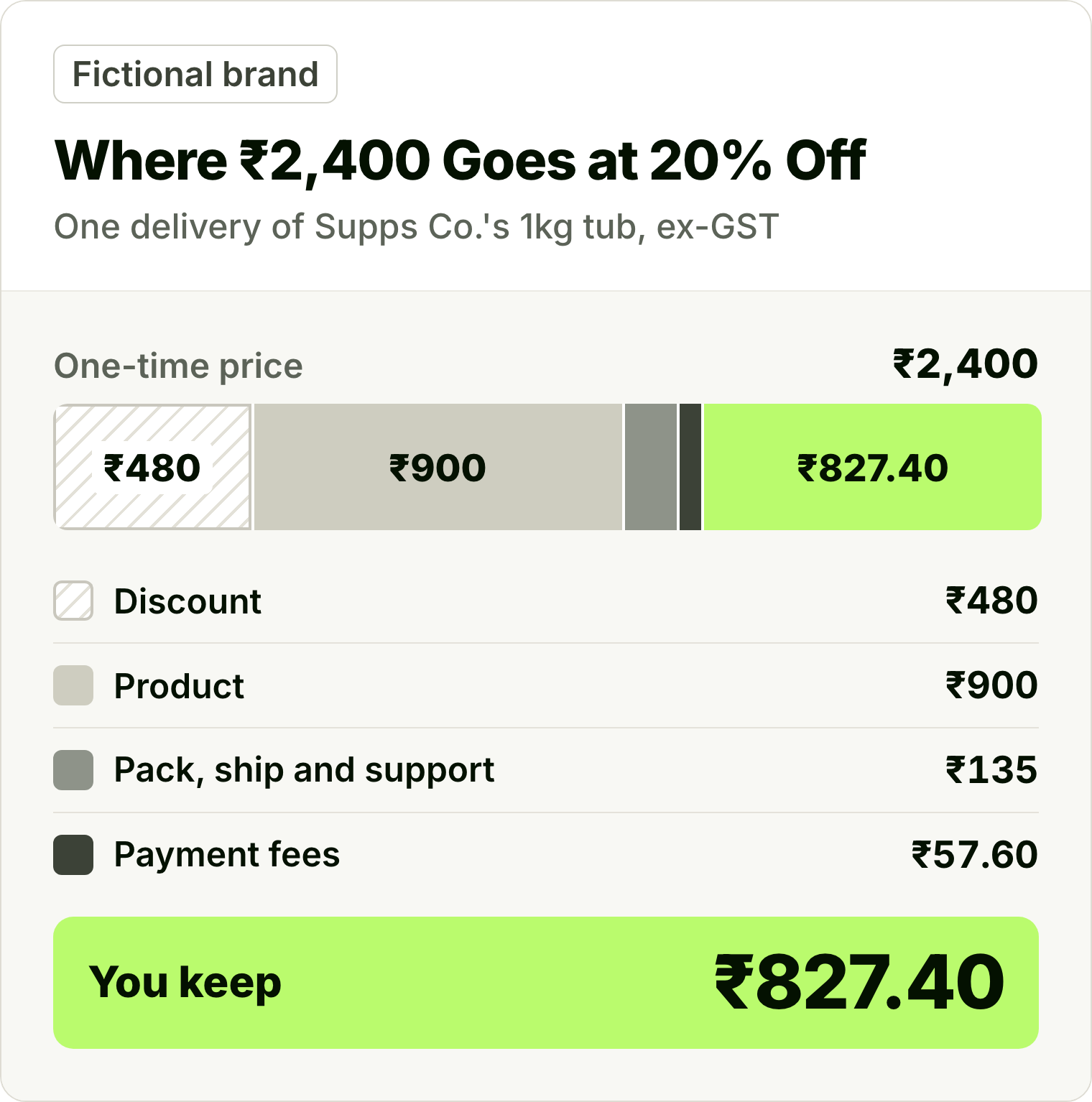
| Discount | Kept per tub (₹, ex-GST) | Margin given up |
|---|---|---|
| 0% | 1,293.00 | 0% |
| 10% | 1,060.20 | 18% |
| 15% | 943.80 | 27% |
| 20% | 827.40 | 36% |
| 25% | 711.00 | 45% |
Supps Co. is fictional. Figures are before acquisition cost and overheads; swap in your own.
Read 20% off as a trade. Supps Co. keeps ₹465.60 less on each tub. In return it gets ₹5,760 today for three tubs and keeps ₹2,482 across them. It spends nothing on ads to win the same customer back for tubs 2 and 3. The table tells you what you can afford, not to go lower than the customer will take.
Discount levels by model, tiered discounts and a second worked example: Subscription Pricing and Discounts.
On the card: a discount for each plan, and what you keep per delivery.
6. Freebies: Which Gifts, on Which Delivery
A freebie is a cost you choose instead of a deeper discount. It earns its place by getting used or by delighting. And it can land on any delivery, not only the first.
- Use: something they reach for with your product, like a shaker, a travel tub, a pill organiser or a glass jar. Announce it on the plan, because it sells the plan.
- Delight: nothing to do with the product, everything to do with how they feel about you. A gym towel, a tee, a handwritten note or a new flavour. Best as a surprise.
| Job | Lands on | Example |
|---|---|---|
| Lower the first yes | Delivery 1 | AG1 prints the value of its welcome kit. Seed's first month comes in a reusable glass jar |
| Open the next plan | Delivery 2 | Electrolyte sachets in the protein box. A sample that gets used becomes the next plan |
| Reward the stay | Delivery 3 or later | A second flavour or a premium shaker, where people usually drop off |
| Delight | Any, unannounced | The towel, the tee, the note. They cost little and get photographed |
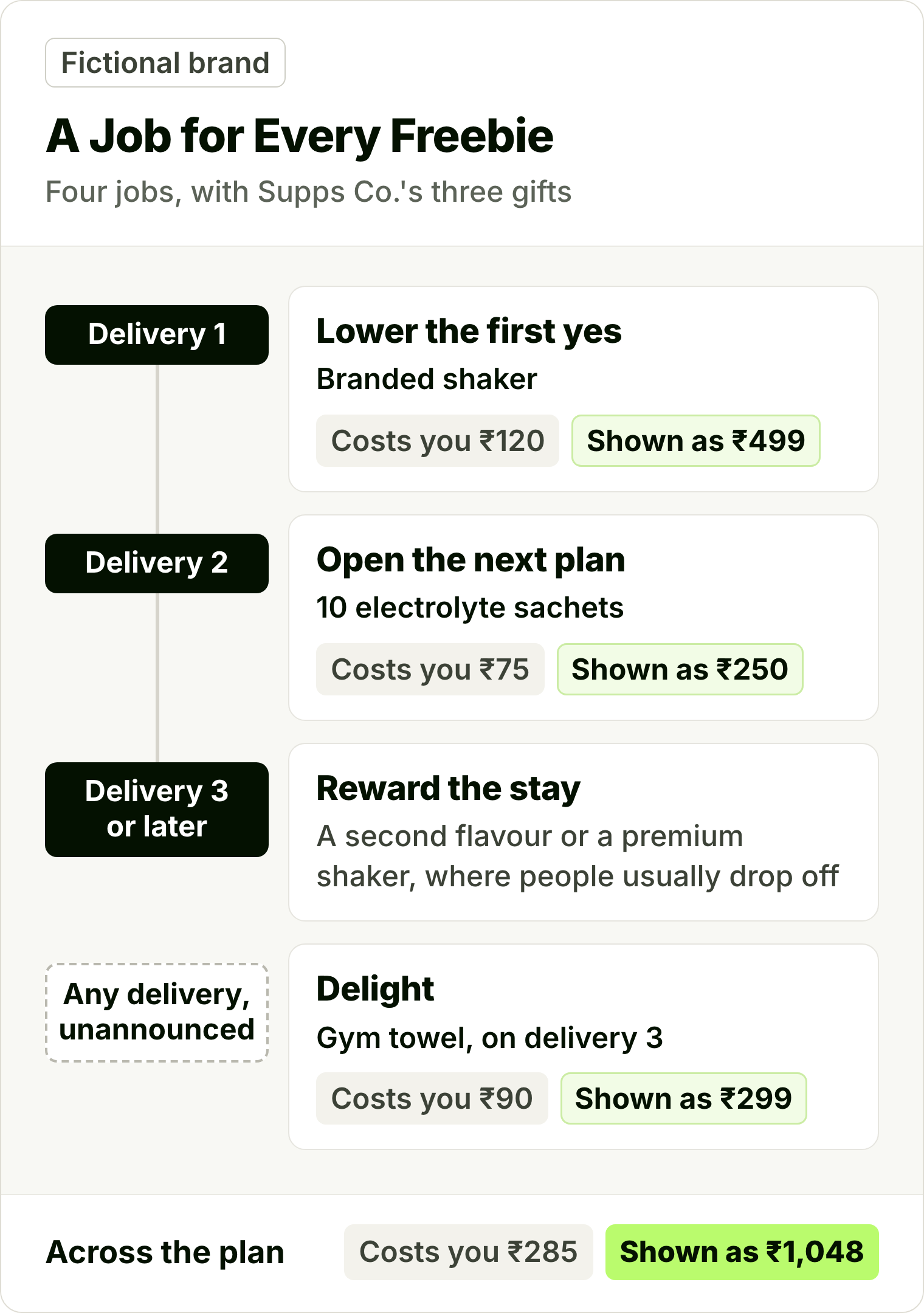
Several small gifts beat one big one: three gifts over three deliveries are three reasons to stay.
Price each freebie at what it costs you, and show it at what it's worth to them.
| Supps Co. freebie (fictional) | Job | Lands on | Costs you | Shown as |
|---|---|---|---|---|
| Branded shaker | Lower the first yes | Delivery 1 | ₹120 | ₹499 |
| 10 electrolyte sachets | Open the next plan | Delivery 2 | ₹75 | ₹250 |
| Gym towel | Delight | Delivery 3 | ₹90 | ₹299 |
| Total across the plan | ₹285 | ₹1,048 |
That's ₹95 per tub, so what Supps Co. keeps drops from ₹827.40 to ₹732.40. The customer sees ₹1,048 of gifts on top of 20% off.
Choose freebies from your own catalogue first: they cost margin, not cash, and sell themselves next time. Keep them in stock for every delivery you promised them on, and make sure they survive the courier. On StackBack, a freebie can go on any delivery you choose, on several, or on all of them.
On the card: up to three freebies, the delivery each lands on, what each costs you and what it's shown as.
7. Promise: Lead the Page With Five Things, Not a Percentage
The brands winning at subscription don't lead with a percentage. They stack five things on the product page, and the discount is the smallest of them:
- A first-order freebie, with its value shown.
- A price per use: ₹1,920 a tub reads as ₹64 a scoop.
- Plans side by side, with the one-time price struck through and the full charge stated under each plan.
- A benefit that grows with commitment: 20% upfront, 10% per delivery.
- The controls, listed under the price: add, swap, reschedule, cancel.
Then sum it up in one line the customer can repeat: "Your next tub before your last scoop, shaker on us." How to build each part: The Subscription Product Page: 5 Parts That Get the Yes.
On the card: the price as shown, the control line and the promise.
Your Offer Card
Fill every box for one product. If you can, you have an offer. The second column names the decision that answers each box.
| Box | Decision | Supps Co. example (fictional) |
|---|---|---|
| Audience | 1. Product | 620 repeat buyers of the 1kg whey |
| Repeat share and gap | 1. Product | 33% repeat; about every 33 days |
| Product and packs | 2. Cadence | 1kg (default), 2kg |
| Delivery rhythm | 2. Cadence | 1kg monthly; 2kg every 2 months |
| Structure | 3. Structure | Single product, with flavour swaps |
| Payment and term | 4. Payment | 3 months prepaid; monthly AutoPay on UPI and cards |
| Discount | 5. Discount | 20% prepaid; 10% AutoPay |
| Kept per delivery | 5. Discount | ₹827.40; ₹732.40 after freebies |
| Freebies | 6. Freebies | Shaker on delivery 1, sachets on 2, surprise towel on 3 |
| Price as shown | 7. Promise | ₹1,920 a tub, ₹64 a scoop, ₹5,760 once |
| Control line | 7. Promise | Add, swap, reschedule or cancel anytime |
| Promise | 7. Promise | Your next tub before your last scoop, shaker on us |
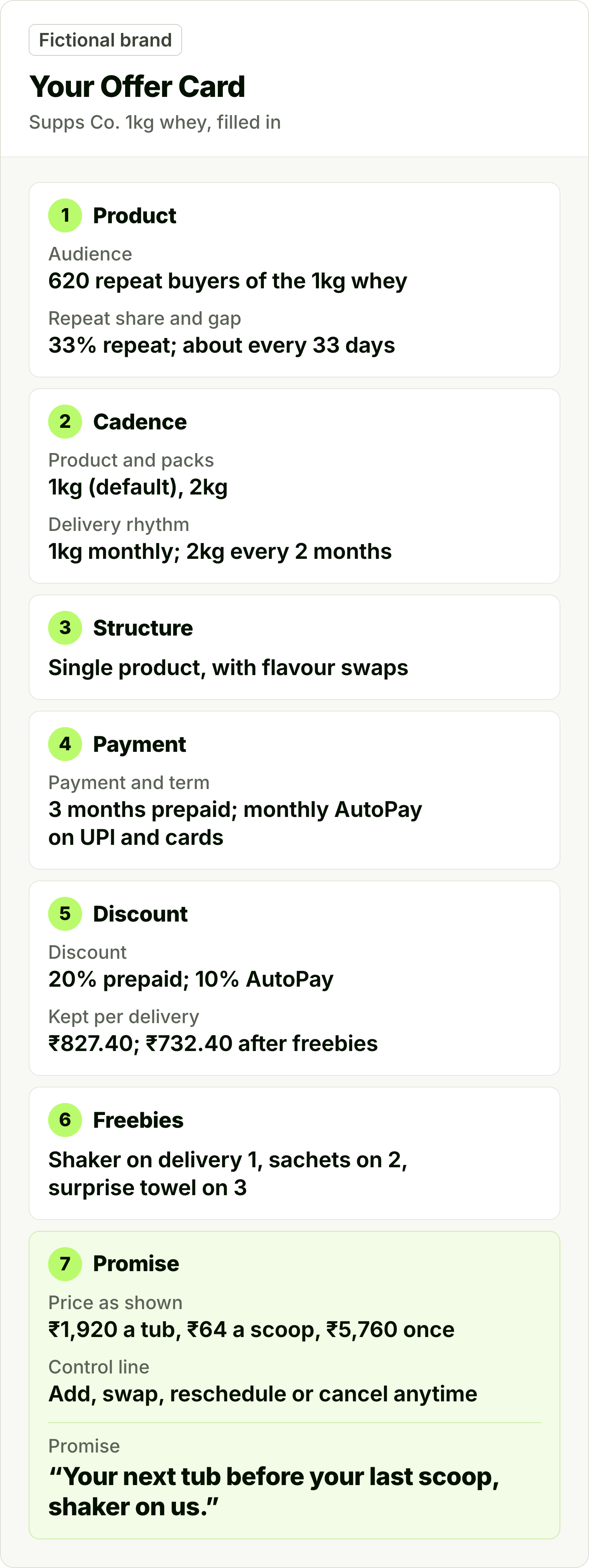
Now yours:
| Box | Decision | Your offer |
|---|---|---|
| Audience | 1. Product | |
| Repeat share and gap | 1. Product | |
| Product and packs | 2. Cadence | |
| Delivery rhythm | 2. Cadence | |
| Structure | 3. Structure | |
| Payment and term | 4. Payment | |
| Discount | 5. Discount | |
| Kept per delivery | 5. Discount | |
| Freebies | 6. Freebies | |
| Price as shown | 7. Promise | |
| Control line | 7. Promise | |
| Promise | 7. Promise |
Every box can be set up on StackBack, along with notices before each AutoPay charge and a customer portal for skips, pauses, swaps and reschedules. Next, take the card to Part 2: How to Get Your First 100 Subscribers on Shopify.
Frequently Asked Questions
What makes a good subscription offer?
One pack people already buy again, delivered as often as they finish it. Add a way to pay that suits them, a discount your margin can carry, gifts across deliveries and a one-line promise.
Which product should I put on subscription first?
The pack your customers already buy again, ranked by repeat share, not revenue. Two ShopifyQL queries find it: see Which Products to Sell on Subscription.
How much discount should a subscription offer in India?
In our experience, 15–20% or more converts. Put the biggest discount on the longest prepaid plan, and check what you keep per delivery first.
Should I offer prepaid, pay-as-you-go or AutoPay on UPI and cards?
Start with two, and only ones you can name a customer for. Prepaid and AutoPay on UPI and cards is the strongest pair. Add pay-as-you-go for customers who won't set up AutoPay.
Are freebies better than a bigger discount?
Often. A freebie costs you its landed cost, but the customer sees its full value. Spread across deliveries, gifts give subscribers reasons to stay.
Should customers choose their own delivery frequency?
Offer two or three packs, each with its own rhythm, instead of one pack with a menu of frequencies. Customers can still reschedule a delivery when they need to.
Can I sell a bundle on subscription?
Yes, if the items are finished at the same speed. If one runs out weeks before the others, sell it as a single product instead.
What happens if an AutoPay payment fails?
On StackBack, it's retried up to three times. Then the subscription pauses or moves to pay-as-you-go, whichever you choose. Nothing ships unpaid.
Launch the Offer You Designed
Prepaid, pay-as-you-go and AutoPay on UPI and cards, freebies on any delivery and a customer portal, on your own Shopify store. Our team takes you live in 2 days.
Sources: Blue Tokai Coffee, subscriptions page; Setu, product subscription options; AG1, product page; Seed, DS-01 Daily Synbiotic page. All checked 3 Nov 2026, cited by name.