Choose Your Box Type
Three kinds of box sell in India, and each runs differently.
| Box type | Who picks what's inside | Best for | Watch out for |
|---|---|---|---|
| Curated box | You do, every cycle | Discovery and gifting: coffee origins, snack tasting, festive hampers | Stock planning across many products; interest fades once the surprise wears off |
| Build-your-own box | The customer, from a menu you set | Brands with several flavours or variants: protein, snacks, tea, skincare | Too many choices slow people down; keep the menu tight |
| Replenishment box | Nobody: the same essentials ship each time | Products people run out of: coffee, ghee, atta, pet food, diapers | Needs the right cadence, or boxes pile up at home |
Curated Box
A curated box is a fixed set you choose. The customer is buying your edit: three new coffees a month, a tasting box of regional snacks, or a festive hamper. People search "curated box" when they want something chosen for them, often as a gift. Plan each edition three cycles ahead, and keep one familiar favourite in every box.
Build-Your-Own Box
A build-your-own box lets the customer pick items from a menu you set, usually with a saving that grows with the box. "Pick any 3 for 15% off" is easy to grasp. A tiered box adds steps, for example 15% off three items, 20% off four and 30% off six or more. It's what shoppers mean when they search "build a box".
Replenishment Box
A replenishment box ships the same essentials on a rhythm. It's the simplest to run, and the need comes back on its own when the product runs out. Many brands start here, then add a rotating item as a surprise.
Mix Them
Most good boxes are hybrids. A fixed core of essentials plus one rotating item gives both reliability and surprise. Let subscribers swap items from a customer portal, so the box stays theirs.
Pick Products That Earn Their Place
- They get used up. Coffee, tea, snacks, ghee, protein, pet food, skincare refills and diapers all come back on their own.
- They travel well. Weight and fragility decide your shipping cost. Glass jars and liquids need tested packaging.
- They keep. Shelf life must cover time in transit plus time on a kitchen shelf.
- They leave margin. A box of low-margin items can't carry a discount and free shipping.
- You can stock them. Plan stock for three cycles for every subscriber you expect.
To test demand, look at customers who already buy two of your products together. In Shopify, a customer segment of people who bought product A and product B finds them. They're your first box subscribers. Our first 100 subscribers playbook shows how to invite them.
Set the Cadence
- Match it to use. Weekly for milk and fresh food, fortnightly for coffee, monthly for most boxes, every two months for slow-use products like skincare.
- Fix the date or roll it. Curated boxes ship on a fixed date each month, so every subscriber gets the same edition. Replenishment boxes ship on a rolling date from each customer's first order.
- Let customers change it. They should be able to change the cadence, skip a box or pause for travel. A box that arrives before the last one is finished is an easy reason to cancel.
Price the Box
Build the price up from your costs, not down from someone else's box. For each box, add up:
- products, at landed cost
- packaging: the box, inserts, tape and a card
- pick, pack and shipping
- payment fees: your gateway's fee plus GST on it
- the subscription discount
- any gift in the box
Then check what's left against the margin you need.
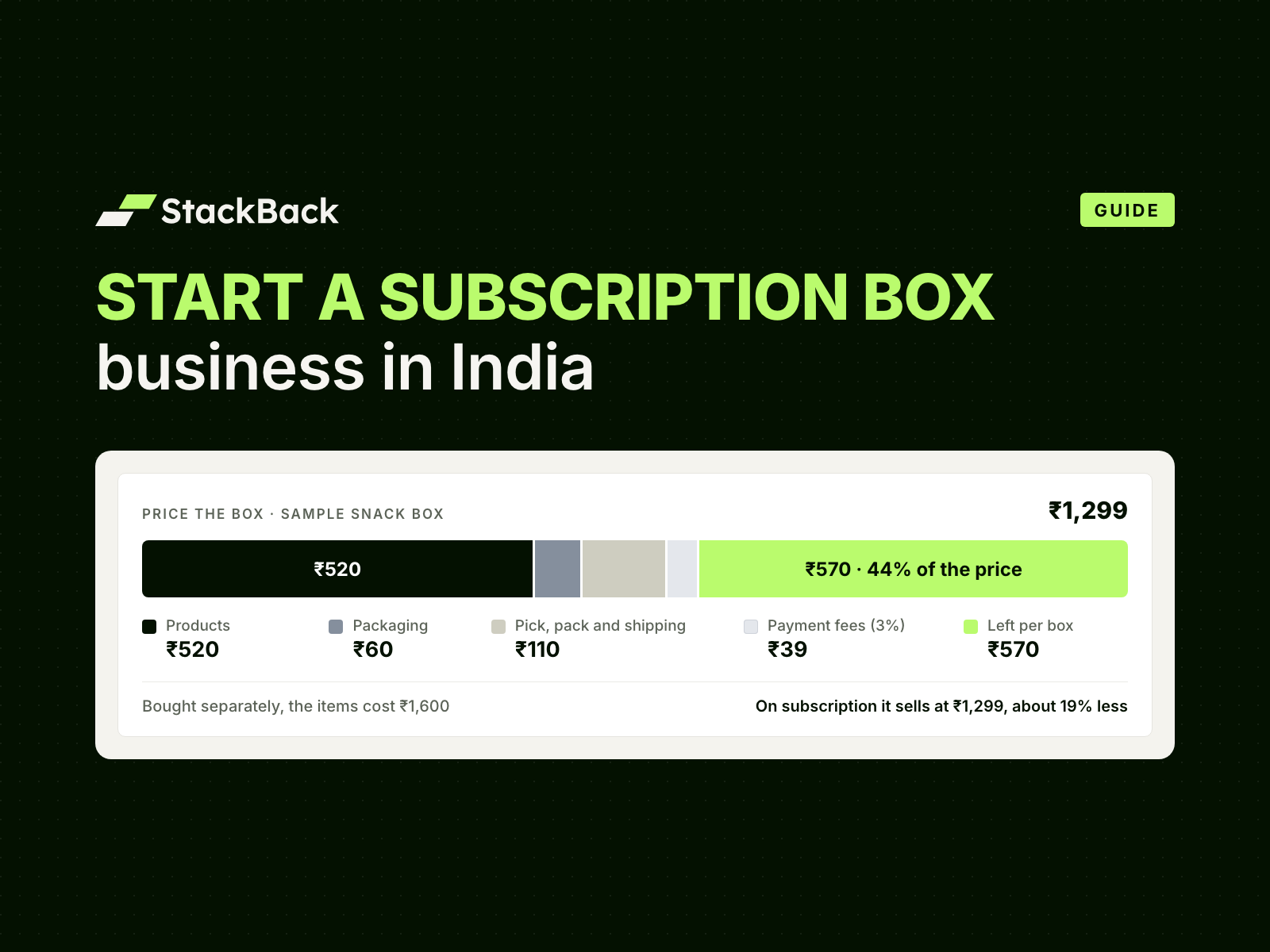
Here's a sample four-item snack box. Bought separately, the items cost ₹1,600. On subscription, the box sells at ₹1,299, about 19% less.
- Products: ₹520
- Packaging: ₹60
- Pick, pack and shipping: ₹110
- Payment fees (3%): ₹39
- Left per box: ₹570, or 44% of the price
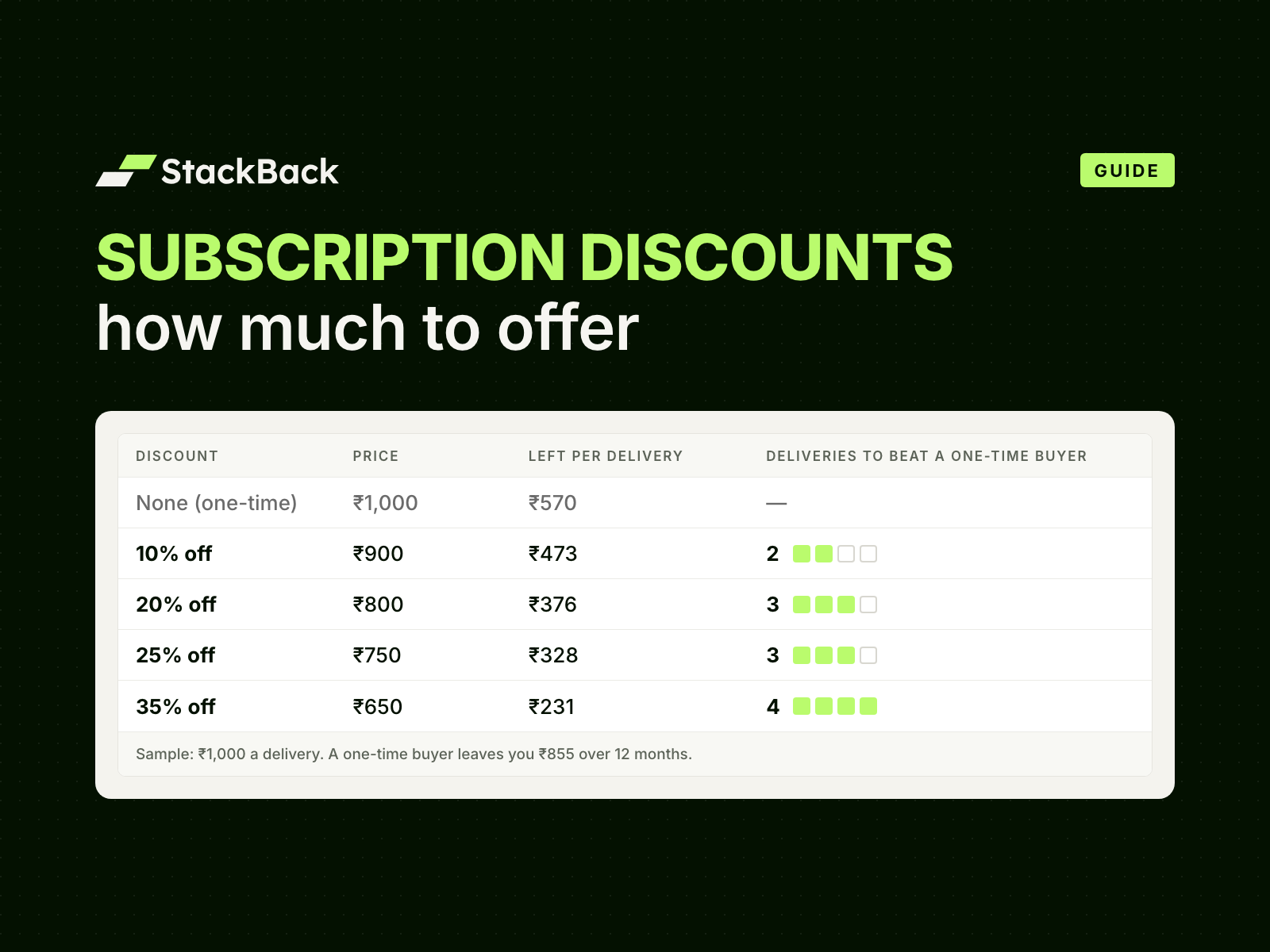
Offer two or three box sizes, so customers can pick a price they're comfortable with. Give prepaid plans of 3 or 6 boxes your biggest discount, because the cash comes upfront and the boxes are committed. For how much to give on each plan, see subscription discounts and pricing.
Shipping, Returns and COD
Cash on delivery is where box businesses lose money quietly. Unicommerce's India D2C report (April 2026) covers 6,000+ brands. During the festive quarter, 58% of COD orders came back, against under 15% of prepaid orders.
A refused box costs you shipping both ways, plus the packaging. On a subscription, that risk comes back with every box.
- Keep subscriptions prepaid where you can. If you allow COD, make prepaid the better deal, with a bigger discount or a gift.
- Check pin codes before you accept a subscriber, so you never sell a box you can't deliver.
- Fix a dispatch day, and send tracking on WhatsApp the day each box ships.
- Replace damaged boxes fast. A damaged box is a quick way to lose a subscriber.
Three Ways to Pay for a Box
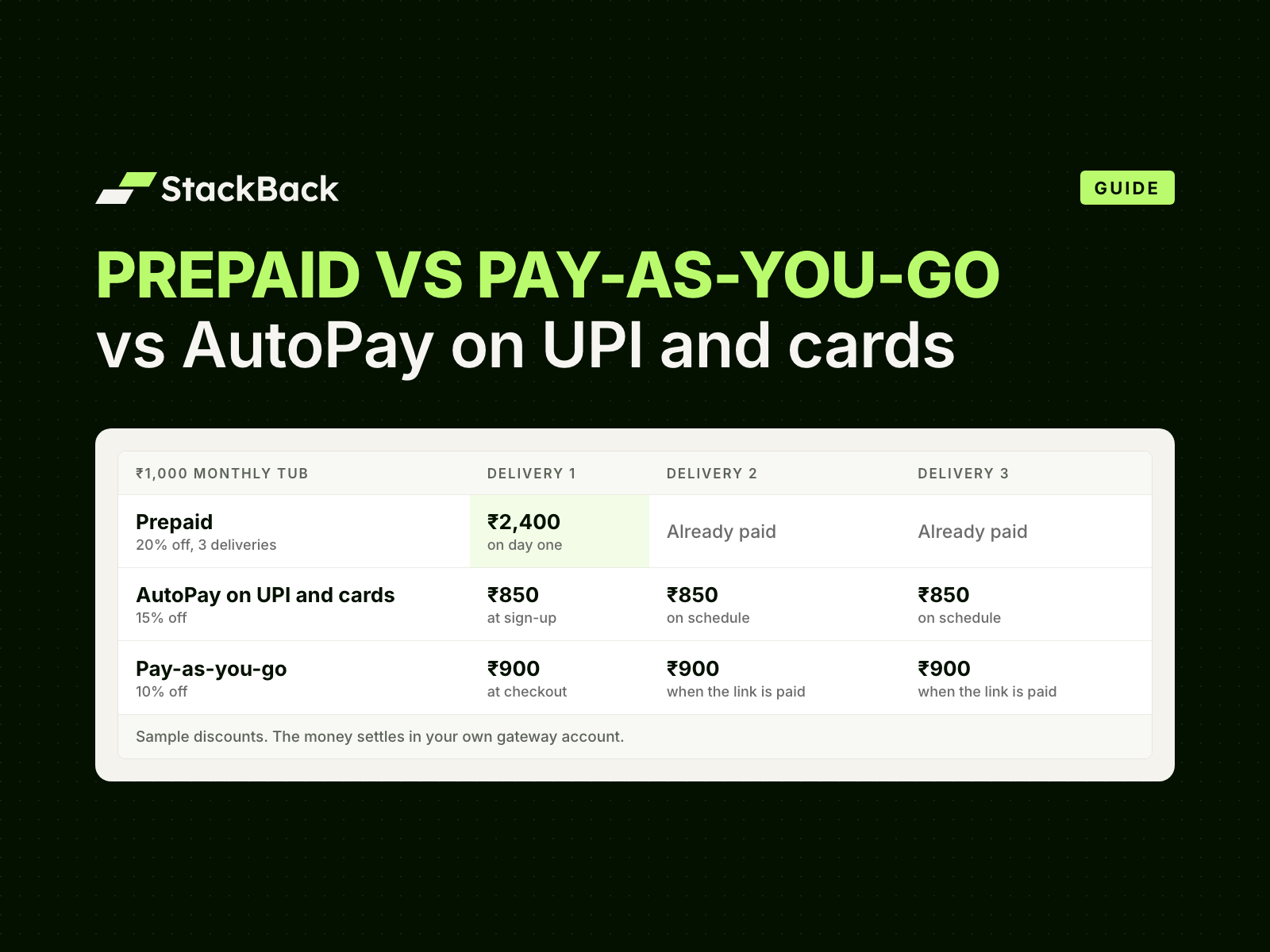
Offer all three on the same page, and let each customer choose. The money settles in your own gateway account.
- Prepaid. The customer pays upfront for 3 or 6 boxes. It's added to the cart from the product page like any other product. It's bought on your Shopify checkout or any quick checkout, with the gateway you already use. It gives you the best cash flow and usually carries the biggest discount.
- Pay-as-you-go. The customer pays for the first box at checkout, then pays a link before each box after that. Nothing is charged automatically, so it's the easiest yes for someone trying a box for the first time.
- AutoPay on UPI and cards. The customer pays for the first box and sets up AutoPay in the same step. This happens on StackBack's subscription checkout, through your own gateway account. Later payments are collected on schedule, with a notice 48–72 hours before each one.
AutoPay payments up to ₹15,000 go through without an OTP. For boxes priced above that, offer prepaid. More on the rules in UPI and card AutoPay rules, and on choosing between models in AutoPay vs prepaid vs pay-as-you-go.
Let Customers Pay for a Box Their Way
Prepaid, pay-as-you-go and AutoPay on UPI and cards for the same box. Our team sets up all three and takes you live in 2 days.
GST and Legal Basics
This is a short summary, not tax or legal advice. Check your setup with your CA.
- Mixed boxes and GST. Items that could be sold separately but are sold together for one price form a "mixed supply". GST treats the whole box as the item with the highest tax rate. That's sections 2(74) and 8 of the CGST Act, 2017, as CBIC's flyer on composite and mixed supply explains. Check rates before you add one high-rate item to a low-rate box.
- Food boxes need FSSAI. Every food business must hold an FSSAI licence, or a registration if it's small (Food Safety and Standards Act, 2006, section 31).
- Selling online has its own rules. The Consumer Protection (E-Commerce) Rules, 2020 set out duties for businesses selling online, including a way for customers to raise and resolve complaints.
- No dark patterns. The Central Consumer Protection Authority's Guidelines for Prevention and Regulation of Dark Patterns, 2023 list 13 banned practices. They include subscription traps, drip pricing and false urgency. Show the full charge before payment, make cancelling easy, and run countdowns only when the deadline is real.
Launch on Shopify
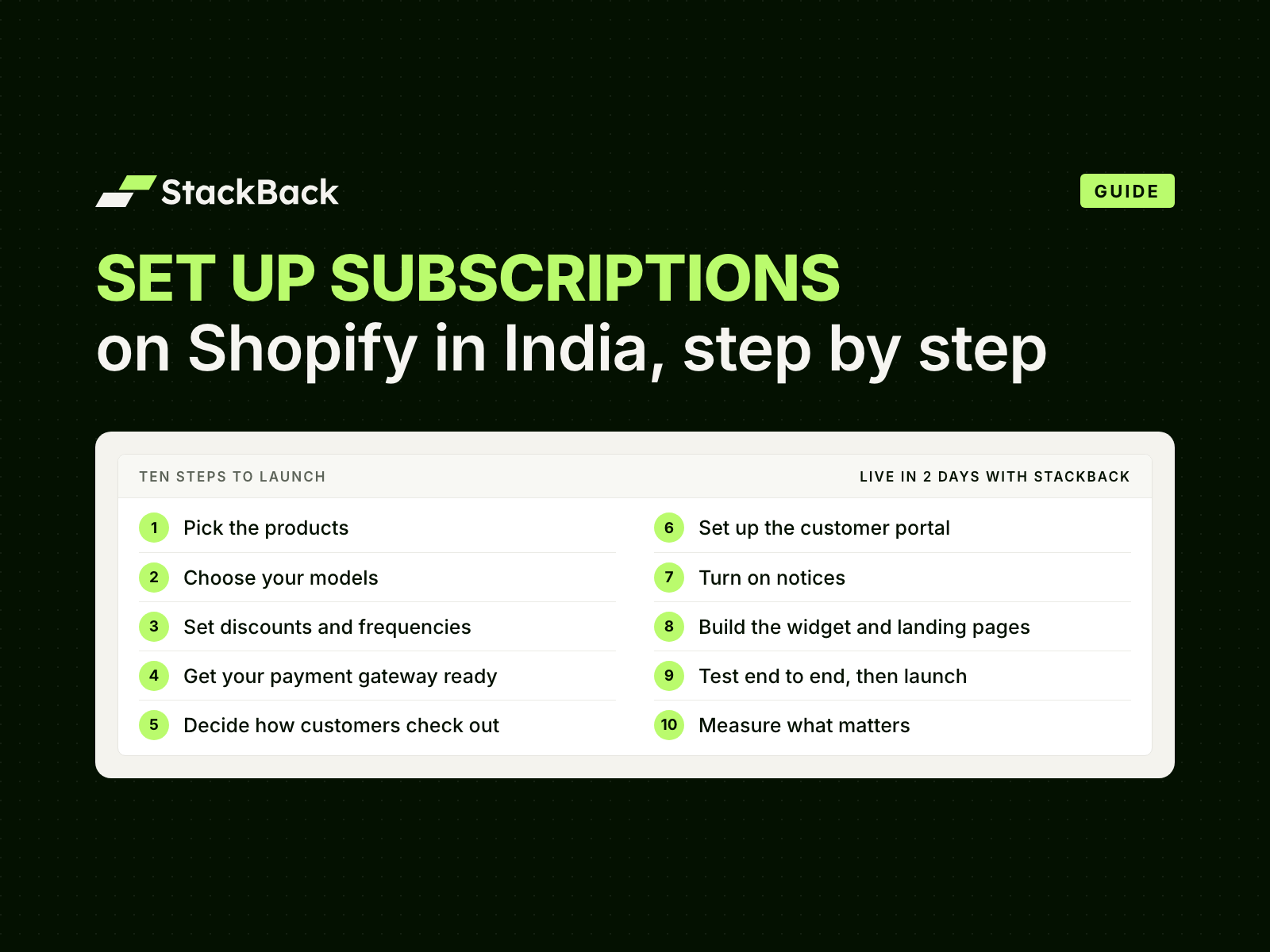
- Set up the box. The products, the box sizes, the menu for build-your-own, and each plan with its discount.
- Put the subscription on the product page, under the price and above the buy button, with one-time purchase still visible.
- Give each box its own landing page. Show the box, the plans, what's inside, how it ships, how to pause or cancel, and short FAQs. Send every ad and invitation there.
- Invite your own repeat buyers first, then people who visited your site. Cold audiences come last.
- Make box 2 land. Put a card in box 1 with the next date, what's coming and a link to the customer portal.
The full Shopify setup is in how to set up subscriptions on Shopify in India.
Festive Boxes
India's gifting calendar suits box brands: Raksha Bandhan, Diwali, Christmas and New Year, plus weddings and corporate gifting.
- Sell a curated festive box once, as a gift, with its own delivery address.
- Add a hamper builder, so buyers make their own gift box from your range.
- Put a subscription invitation inside the festive box. A card invites the person who receives it to keep the box coming after the festival.
- Give each festive box its own landing page, and plan stock well before the season.
- Keep deadlines real. A countdown has to end when it says it will.
How StackBack Handles This
StackBack runs build-your-own boxes, mix & match, fixed boxes and bundles, and buy X get Y. Each sells once or on subscription. Prepaid, pay-as-you-go and AutoPay on UPI and cards sit side by side. StackBack is the only subscription platform that works with India's quick checkouts, for prepaid and pay-as-you-go plans. Each box gets a one-click landing page, and subscribers skip, swap or pause from the customer portal.
Each subscription order appears in Shopify once that delivery is due and paid, tagged Subscription, so your team packs it like any other order. You integrate StackBack with your Shopify store, our team sets up your plans, and we take you live in 2 days. Plans start at ₹4,500/month, with 0% transaction fees. See the platform.
Frequently Asked Questions
What is a curated box?
A curated box is a set of products the brand chooses, shipped together, often monthly or as a gift. The customer doesn't pick the items. They're paying for your selection.
What's the difference between a curated box and a build-your-own box?
A curated box is a fixed set you choose. A build-your-own box lets the customer pick items from a menu you set, often with a bigger saving for a bigger box. Both can be sold once or on subscription.
Can I offer cash on delivery on a subscription box?
You can, but keep it limited. Unicommerce's April 2026 data shows 58% of COD orders came back during the festive quarter, against under 15% of prepaid orders. Make prepaid the better deal with a bigger discount or a gift.
How is GST charged on a box with different products?
If the items are sold together for one price, GST treats the box as a mixed supply. It's taxed at the highest rate of any item in it (CGST Act, 2017, sections 2(74) and 8). Check with your CA before you finalise a box.
How often should a subscription box ship?
Monthly suits most boxes. Ship weekly for fresh food and milk, fortnightly for coffee, and every two months for slow-use products. Let customers change the cadence themselves.
How do customers pay for a subscription box in India?
Three ways: prepaid for several boxes, pay-as-you-go before each box, or AutoPay on UPI and cards. Offer all three and let each customer choose.
Launch Your Box on Shopify
Build-your-own boxes, fixed boxes and bundles, sold once or on subscription, with all three ways to pay. Our team takes you live in 2 days.
Sources: CBIC, GST flyer: Composite Supply and Mixed Supply · CGST Act, 2017, sections 2(74) and 8 · Food Safety and Standards Act, 2006, section 31 · PIB, CCPA issues Dark Patterns Guidelines, 2023, 8 Dec 2023 · Unicommerce, India D2C Report, April 2026 (cited by name)