Voluntary vs Involuntary Churn
Voluntary churn is a decision. The customer cancels in your portal, writes to support, or cancels the mandate in their UPI app.
Involuntary churn is an accident. The customer meant to stay, but a payment failed and nobody recovered it.
Silent churn is the Indian extra. A pay-as-you-go subscriber gets a payment link before each delivery. If they don't pay, nothing ships, and the subscription quietly stops. It's the same weakness as emailed invoices, the fallback global subscription tools use in India. Our guide to Shopify subscriptions in India explains that gap.
Each needs a different fix:
- Voluntary churn is an experience problem: the plan doesn't fit their life.
- Involuntary churn is a payments problem: retries and fallbacks.
- Silent churn is a reminder problem, and a reason to move regular payers to AutoPay.
How to Measure Churn
Start with one number, then split it.
- Monthly churn rate: subscribers who stopped this month ÷ subscribers at the start of the month. Count people, not subscriptions.
- By model: prepaid, pay-as-you-go and AutoPay subscribers leave for different reasons.
- By cause: cancelled, payment failed, link unpaid, or prepaid plan ended.
- By delivery: how many reach delivery 2, 3 and 6. Watch the first three closely, while the habit is still forming.
Public churn benchmarks for Indian D2C subscriptions are thin, and global figures mix in streaming and software. Benchmark against your own last quarter, product by product.
The Real Reasons Subscribers Cancel
Ask for the reason at the moment of cancelling: one question, one tap. Then fix the biggest reason first.
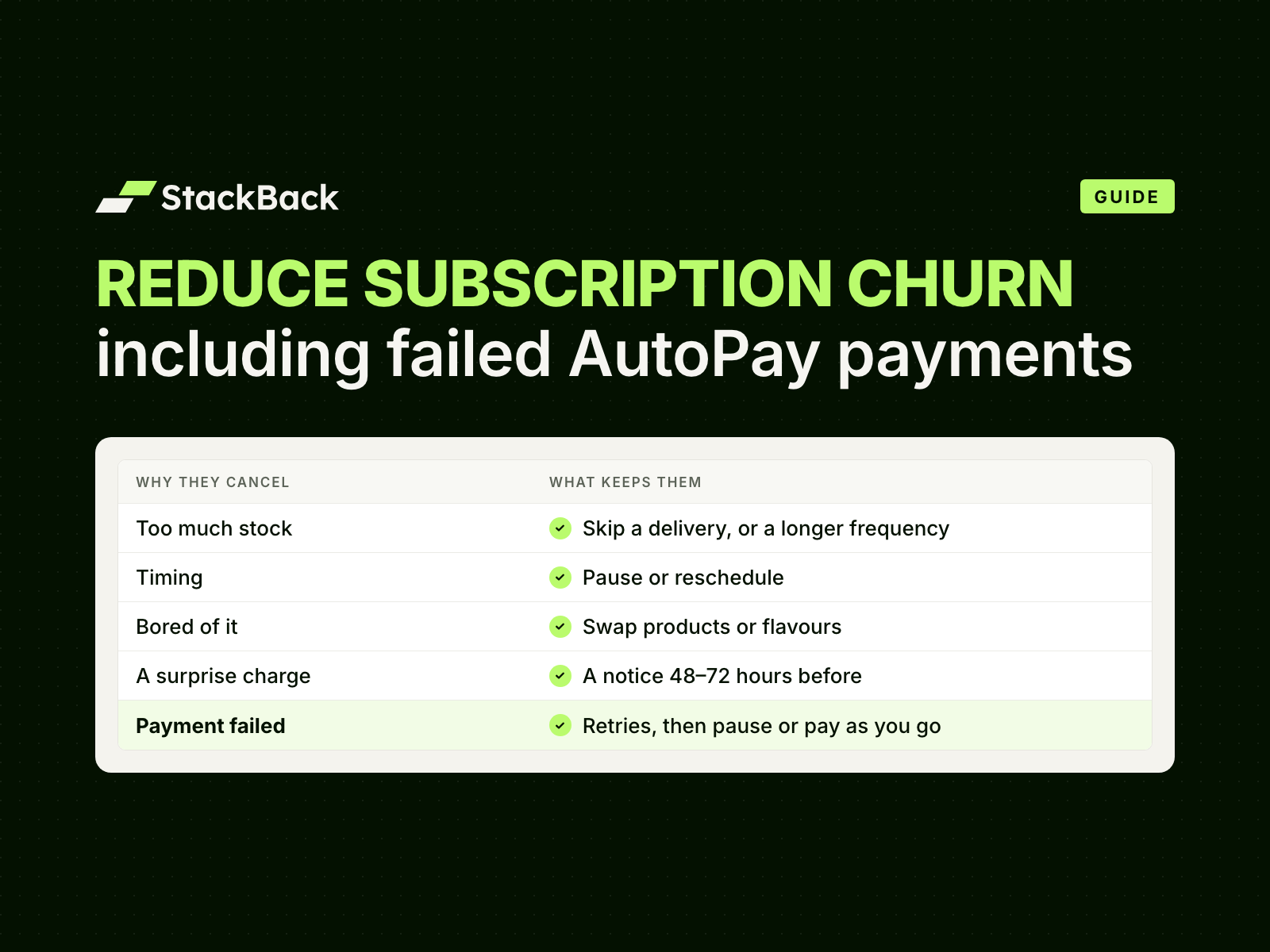
| Reason | What it sounds like | What keeps them |
|---|---|---|
| Too much stock | "I still have half a pack." | Skip a delivery, or a longer frequency |
| Timing | "I'm travelling next month." | Pause or reschedule |
| Bored of it | "I want to try something else." | Swap products or flavours |
| Price | "It's too expensive." | Show the per-use price; offer a prepaid plan at a better rate |
| A surprise charge | "I didn't know I'd be charged." | A notice 48–72 hours before, with a link to manage |
| Payment failed | Nothing: they didn't notice. | Retries, then a payment link and a nudge back to AutoPay |
| Forgot the link | Nothing: the link went unpaid. | A clear reminder, then an invite to AutoPay |
| Product or delivery issue | "The last box arrived late." | A person replies the same day; fix the cause |
| Needs changed | "I don't use it anymore." | Cancel cleanly; win them back later |
Fit the Cadence to Real Use
A subscription that arrives too often builds a pile of unused stock. A pile is the start of a cancellation.
- Set the default from your order data. Use the usual gap between repeat orders of that product.
- Offer two or three frequencies, such as every 2, 4 or 6 weeks.
- Let customers change it in the portal. A frequency change is a save, not a loss.
- Watch the skips. A customer who skips every other delivery needs a longer frequency. Suggest it before they cancel.
Pet food is a good example. A growing puppy eats more each month, so the right frequency changes. See how pet food brands handle it.
Give Them Options Before the Cancel Button
The customer portal is your best retention tool. On StackBack, it sits on your own domain, with Shopify login. Customers can:
- skip or reschedule a delivery;
- pause the subscription;
- swap products or flavours;
- change frequency;
- add products to an upcoming delivery or an active subscription;
- cancel.
Make it easy to find: a "Manage subscription" link in your store menu, and in every notice.
A fair cancellation flow:
- Ask why, with one tap.
- Offer the one option that matches the reason. That's a skip for too much stock, a pause for travel, a swap for flavour fatigue, or a better price for cost.
- If they still want to go, cancel straight away and confirm it in writing.
One offer, then let them go. India's dark-pattern guidelines (CCPA, 30 November 2023) treat a hidden or tiresome cancel process as a "subscription trap". A clean exit also keeps the door open for a win-back later.
Failed AutoPay Payments: Fixing Involuntary Churn
Why AutoPay payments fail:
- a low balance on the debit date;
- an expired, blocked or reissued card;
- a payment above the mandate's maximum, after a bigger box;
- a mandate paused or cancelled in the UPI app;
- a bank or UPI outage.
What to do about it:
- Warn first. A notice 48–72 hours before each charge gives customers time to top up, skip or pause.
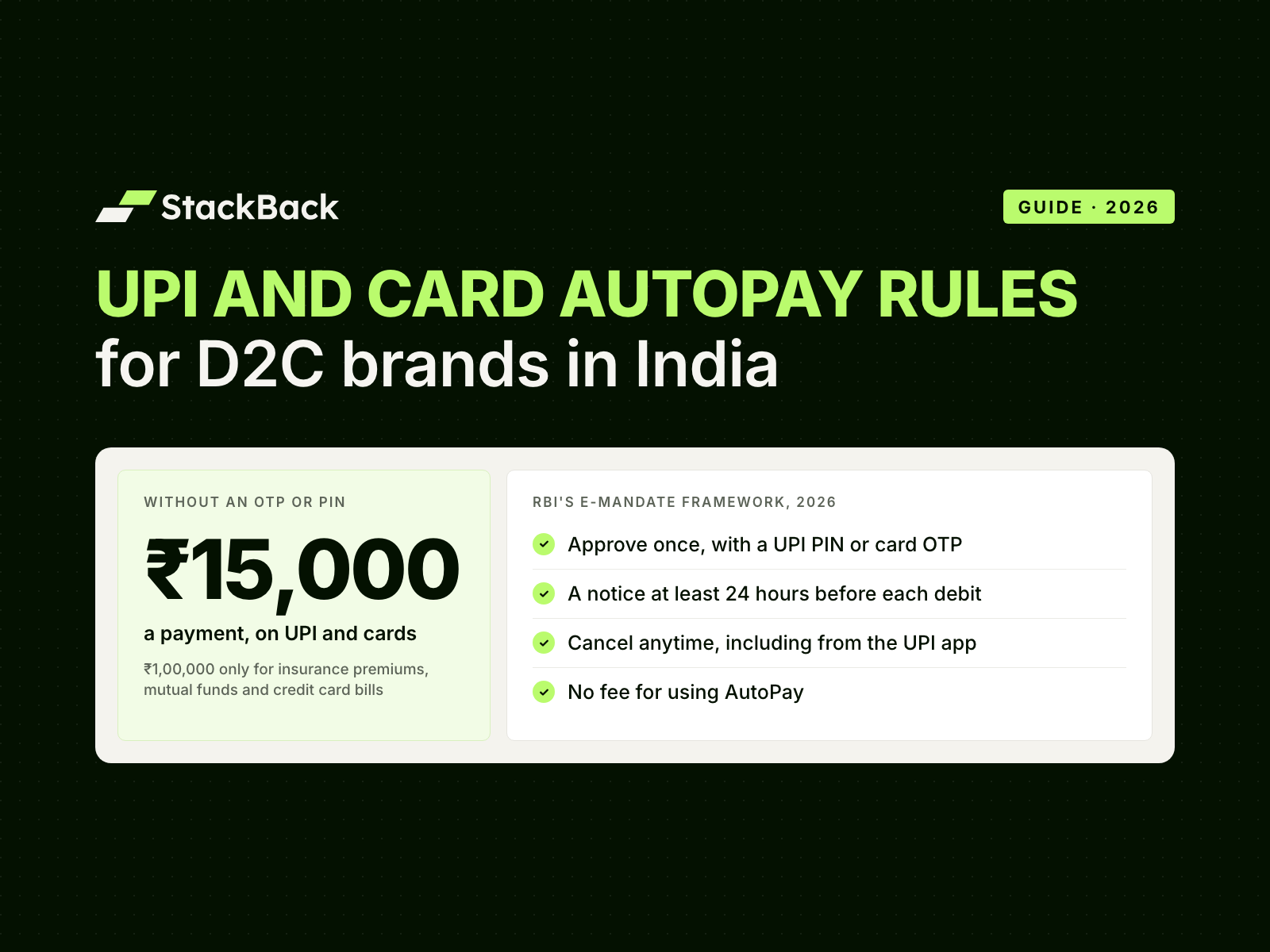
- Leave headroom. Set the mandate limit above the plan price. On StackBack, it's set at up to ₹15,000, or 3–4× the plan price, so an added product doesn't fail.
- Retry within the rules. NPCI allows one attempt and up to three retries on each UPI AutoPay debit, outside peak hours. On StackBack, a failed payment is retried.
- Fall back, don't stop. After 3 failed retries, StackBack can move the subscription to pay as you go. The customer gets a payment link for that delivery, and a nudge to turn AutoPay back on. If you'd rather, the subscription pauses instead.
- Ship only what's paid. The order appears in Shopify once the delivery is paid. Nothing ships unpaid.
- Watch the pattern. If card payments fail more often than UPI on your store, invite card customers to move to UPI AutoPay.
A failed payment is a payments problem, not a decision to leave. Keep the subscription alive, and give the customer an easy way to pay. The rules behind mandates, limits and retries are in our guide to UPI and card AutoPay rules.
Stop Losing Subscribers to Failed Payments
On StackBack, a failed AutoPay payment is retried up to three times. Then the subscription pauses or moves to pay as you go, whichever you choose, and nothing ships unpaid.
Notices That Stop Surprise Cancellations
A charge the customer didn't expect can end in a cancelled mandate. A good notice before each charge or delivery says:
- what's coming, and when;
- how much will be charged, and how;
- any gift in this box;
- one link to skip, swap or change it.
RBI already requires the customer's bank to send a notice at least 24 hours before each debit. Yours should arrive first, and offer more options than "stop".
Keep messages to the ones that matter: the notice, delivery updates and the occasional gift reminder. Anything more starts to read like spam.
Gifts on Chosen Deliveries
Freebies reward staying, not just signing up.
- Pick the gift and the delivery: a sample on the 2nd, a gift on the 7th.
- Choose gifts that help them use the product: a shaker, a scoop, or a sample of a new flavour they can swap to.
- Tell them early: before they subscribe, and again in the notice before that delivery.
- Use them on every model: AutoPay, prepaid and pay-as-you-go.
Where Churn Hides in Each Model
- Prepaid: at the end of the plan. Before the last delivery, send the next plan with a reason to continue.
- Pay-as-you-go: in unpaid links. Send a clear reminder, then invite regular payers to move to AutoPay.
- AutoPay: in failed payments and UPI-app cancellations. Notices, headroom in the limit and the pay-as-you-go fallback cover most of it.
Win-Back: A Light Touch
Some subscribers will leave. A few will come back if you ask well.
- Wait one full delivery cycle after they stop.
- Send one message about their habit, not your discount: "It's been a month since your last tub."
- Offer the plan they had, with a welcome-back gift.
- Stop after one or two messages, and never message anyone who opted out.
The lapsed-regulars list in our first 100 subscribers playbook is a good place to start.
How StackBack Handles This
Every subscriber gets a portal on your own domain to skip, pause, swap products or flavours, change frequency, add products and cancel. You choose whether to offer a skip or a discount before a cancellation goes through. Freebies can go on any delivery you pick. See subscriptions on StackBack.
For AutoPay on UPI and cards, customers get a notice 48–72 hours before every charge, with a link to manage the subscription. A failed payment is retried, and after 3 failed retries the subscription pauses or moves to pay as you go, as you choose. Nothing ships unpaid. More on AutoPay on UPI and cards.
Frequently Asked Questions
What is subscription churn?
The share of subscribers who stop in a given period. Monthly churn is the subscribers who stopped this month, divided by the subscribers you had at the start of it.
What's the difference between voluntary and involuntary churn?
Voluntary churn is a customer choosing to cancel. Involuntary churn is a subscription lost to a failed payment. The first needs a better-fitting plan; the second needs notices, retries and a fallback.
Why do customers cancel subscriptions?
Common reasons are fit and timing: too much stock, travel, a flavour they're tired of, or a price that feels high. Skip, pause, swap and frequency changes in the portal answer most of these.
What happens when an AutoPay payment fails on StackBack?
It's retried. After 3 failed retries, the subscription pauses or moves to pay as you go, whichever the brand chooses. On pay as you go, the customer gets a payment link. Nothing ships until it's paid.
Should I make it hard to cancel a subscription?
No. Offer one alternative, then let them cancel. India's dark-pattern guidelines treat a hard cancellation as a "subscription trap", and a clean exit keeps the door open for a win-back.
What is a good subscription churn rate?
There's no reliable public benchmark for Indian D2C subscriptions yet. Track your own churn by product and by model, and aim to beat last quarter.
Do freebies reduce churn?
They give subscribers a reason to stay until a specific delivery. Put a sample on the 2nd delivery and a gift on a later one, and tell customers in advance.
Keep Them Subscribed Past Delivery 3
A customer portal, notices before every charge and a pause or pay-as-you-go fallback for failed AutoPay payments. Our team takes you live in 2 days.
Sources: RBI, Digital Payments – E-mandate Framework, 2026, 21 April 2026 · NPCI, Guidelines on usage of UPI APIs, NPCI/UPI/OC/215A/2025-26, 21 May 2025 · CCPA, Dark Patterns Guidelines, 2023, 30 November 2023